

Sometime in the mid-1900s, my grandfather’s uncle Calvin Yorks was gifted a blanket by a Southwestern Native American tribe member; the context in which this blanket was gifted is lost to time, and our family does not know the exact origins of the textile or who in particular bestowed the gift to my great-uncle. What we do know is that Calvin and his wife Daisy spent much of their lives traveling and living in the Southwest, eventually settling in Arizona, where they appear to have built strong connections with the local Native communities. By stitching together family lore, historical context, and educated opinion, we can begin creating a chronicle of American history, shared experiences, and family connections that would be right at home in a museum setting. Studying this blanket further in a museum would offer additional important context regarding its creation, offering a stronger understanding of its origins and its cultural and familial significance.
To orient ourselves to this gifted textile, it is important to note that Calvin’s mother was a full-blooded Lenape woman who stole a horse, ran away from her family, and married my great-great-grandfather before quietly settling in upstate New York. Given the violent relationship between the United States federal government and Native American tribes in the 19th and 20th centuries, the fact that my family’s bloodline contained direct Native American heritage was kept strictly under wraps, which kept the family intact and safe while my great-uncle and his siblings were growing up. After Calvin relocated from the Northeast to the Southwest, he kept in contact with his brother Ray (my great-grandfather), who learned that Calvin and Daisy were building relationships with the local tribes, specifically the Hopi tribe and the Diné (Navajo) tribes. It is reasonable to presume that Calvin had shared his family’s Lenape heritage with his new community, so our family has guessed that this blanket served as a gift from one tribesman to another partial tribesman, commemorating a shared respect.
The blanket measures approximately six feet by five feet, and appears to be woven from some kind of soft but sturdy animal wool, likely sheep or alpaca (Fig. 1). The pale pink, green, blue, and white color palette calls to mind Southwestern skies and flora, and the geometric pattern is precisely crafted, suggesting it was woven on a loom rather than entirely created by hand. The edges of the blanket are completed with a hand-stitched selvedge technique, and a blue thread serving as the “spirit line,” which allowed the weaver’s soul to exit the textile, is visible toward one outer edge (Fig. 2, Freund). Given Calvin’s location in Arizona and other neighboring states, our family has presumed that the blanket was created either by a Hopi or Diné individual, as those tribes commanded the strongest presence in the region at the time. However, since we are unable to trace the exact timeframe of the blanket’s creation, and Native tribes in the Southwest often used similar patterns and techniques, it is difficult to determine the complete origins of the blanket without the guidance of an expert in Native textiles.
After Calvin and Daisy passed away, their belongings, including this textile, were given to my great-grandfather Ray, who was the youngest and last surviving sibling in the family. Upon Ray’s passing, my grandfather inherited it, and it was stashed in my grandparents’ basement in New Hampshire until my mother and I rediscovered it in 2008 after my grandfather’s passing. We previously knew very little of our Native American heritage, with my mother only hearing a few stories from her grandfather Ray as she grew up, but finding this blanket prompted my grandmother to share stories she knew of my grandfather’s family and their connections to this blanket. Her knowledge was limited as well, as my grandfather was a private man and his father passed before I was born, but we are grateful for the brief history we do know about this textile. We have started researching museums we can potentially donate or loan the blanket to, partially to share a tangible artifact connecting our family’s present with our past, but also to learn more about the blanket’s origin and what could have inspired someone to gift the blanket to Calvin over a century ago. Regardless of its origins, the Yorks family appreciates this piece of cultural history, and we are eager to learn more about the textile and our family’s connections to Southwestern Native tribes.
Appendix
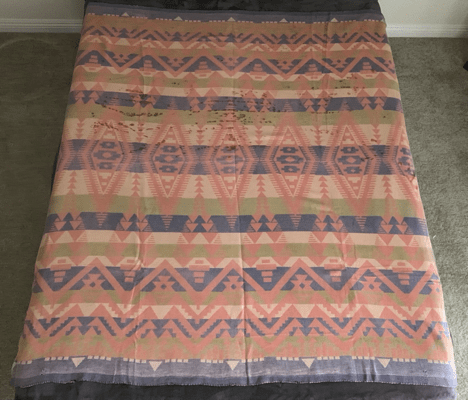
Fig. 1. Native American textile, late 19th or early 20th century. Likely Hopi or Diné (Navajo). Yorks family heirloom. Photograph taken by Sandy Yorks.
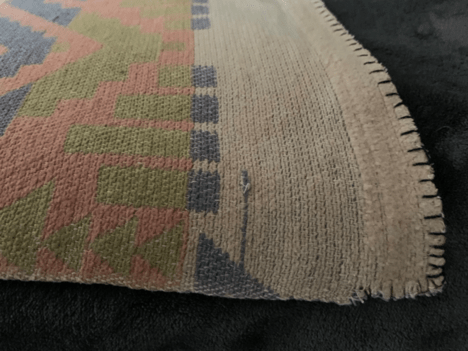
Fig. 2. Detail of Native American textile, late 19th or early 20th century: Spirit Line. Likely Hopi or Diné (Navajo). Yorks family heirloom. Photograph taken by Sandy Yorks.
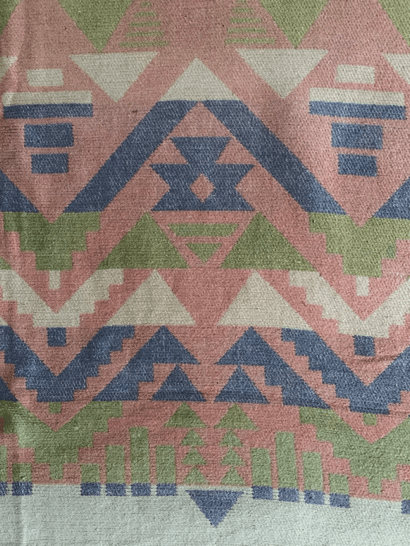
Fig. 3. Detail of Native American textile, late 19th or early 20th century: Pattern and color. Likely Hopi or Diné (Navajo). Yorks family heirloom. Photograph taken by Sandy Yorks.
Works Cited
Freund, Jerry. “The Gift of Spider Woman: Symbols and Motifs in Navajo Weavings.” Canyon Road Arts, 10 Mar 2013, https://www.canyonroadarts.com/symbols-and-motifs-in-navajo-weaving/. Accessed 5 Dec 2024.
Originally written December 2024.
 Art with an Opinion