
Over the weekend, I was treated to an experience of the Immersive Van Gogh experience in Dallas, Texas. Designed by Massimiliano Siccardi and soundtracked by Luca Longobardi, the vibrant exhibit transforms 500,000 cubic feet of blank warehouse space with animated projections of Van Gogh’s art, accompanied by audio, that envelop the audience in the artist’s profound oeuvre of work (“About the Original Immersive Van Gogh Experience”). Siccardi asserts it “[illuminates] the mind of the genius,” sharing Van Gogh’s art in new ways that focus on his artistic process and thoughts (“About the Original Immersive Van Gogh Experience”). Yet in my perspective, the exhibit did not illuminate Van Gogh’s art in a unique way that added to its original narratives so much as it creatively used technology and its social allure to remix Van Gogh into something new that propels this 19th century art into the 21st century.
At its core, Immersive Van Gogh is a simple audio and video installation, and its exhibition space is similarly simple, set up with a few sparse chairs and small side tables. The experience posits the audience as passive, simply sitting and observing, likely with the intent that the colors and sound will flow over the viewer from their static position, adding to the immersive feel. But the animations that flicker across the walls and reflect off the minimal metal sculptures in an adjacent room feel almost too simplistic when imagined as a glimpse into Van Gogh’s mind – while beautiful, they do little to convey his true process or thoughts, and I did not feel I understood Van Gogh any better as I left.
Yet when viewed as a remixed experience, rather than an illumination of an existing artist’s experience, the installation offers something new to conversations around audience engagement and immersive experience. Immensely Instagrammable, the visuals are truly beautiful, and they perhaps engage a new digital-age audience who may not have pursued traditional Van Gogh exhibitions. The admiration Siccardi feels for Van Gogh is evident in the installation’s arresting reimagining of such recognizable works, enlivening each piece in thoughtful ways that honor even as they distort through animated video. The soundtrack, featuring distinguished artists such as Edith Piaf and Thom Yorke, perhaps does the most to carry the viewer into an immersive experience: its melodic and soothing tones complement the animation seamlessly, transforming the blank white space of the warehouse into something magical, modern, and fresh – a remixed take on an old classic.
Touted as an immersive Van Gogh experience, the exhibit both hits and misses its mark. While it does offer an all-encompassing aural and visual experience, the experience does not so much immerse you in Van Gogh as it does in Siccardi’s remix of Van Gogh’s works. As a stand-alone representation of Siccardi’s mind and understanding of the power of technology to engage audiences in the 21st century, the exhibit soars; its viral and enduring presence in numerous cities across the United States demonstrate that technology can (and does) lure audiences with the promise of something new and experiential. Just don’t call it an immersive experience of an artist’s work – call it a remix.
Appendix
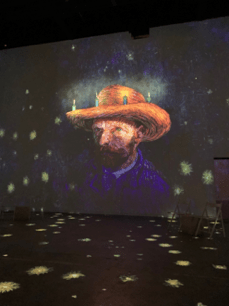
Yorks, Tanya. “Immersive Van Gogh Dallas: During.” 16 September 2022.
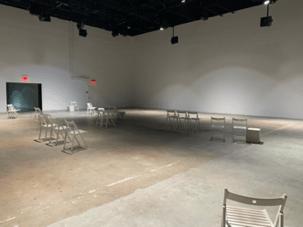
Yorks, Tanya. “Immersive Van Gogh Dallas: After.” 16 September 2022.
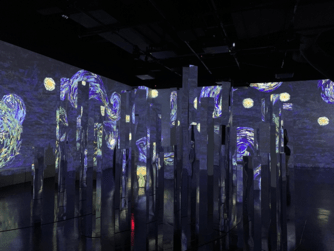
Yorks, Tanya. “Immersive Van Gogh Dallas Sculpture: During.” 16 September 2022.
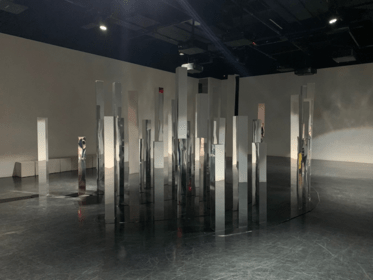
Yorks, Tanya. “Immersive Van Gogh Dallas Sculpture: After.” 16 September 2022.
Works Cited
“About the Original Immersive Van Gogh Experience.” Immersive Van Gogh Exhibit Dallas, https://www.dallasvangogh.com/about/. Accessed 19 Sept 2022.
Originally written September 2022.
 Art with an Opinion